
23 September 2026
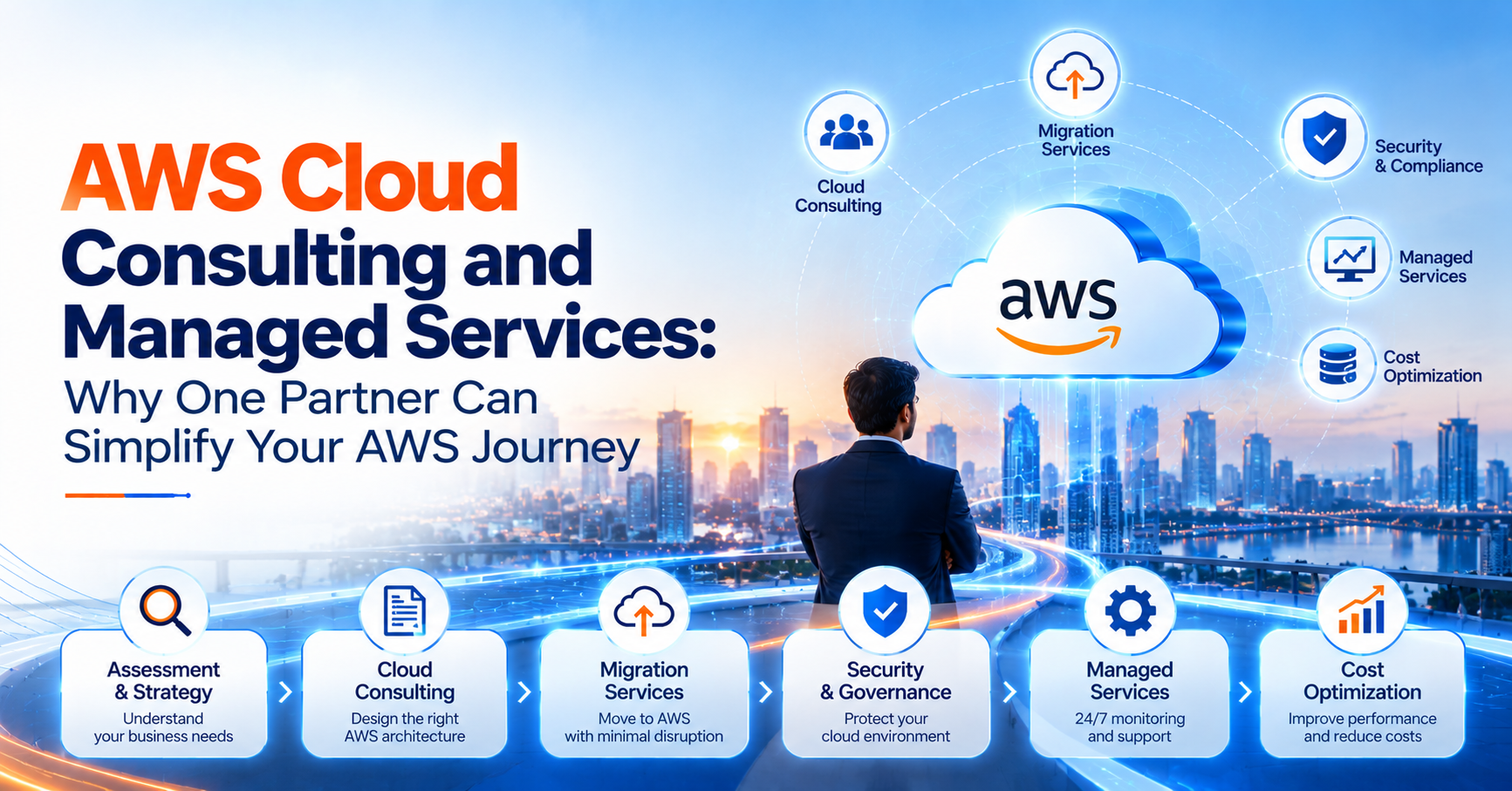
AWS Cloud Consulting and Managed Services: Why One Partner Can Simplify Your AWS Journey
Businesses are moving to the cloud to improve scalability, reduce infrastructure limitations and support digital transformation. However, moving workloads to Amazon Web Services (AWS) is only one part of the journey. Companies must also make the right architectural decisions, protect their environments, control cloud spending and maintain reliable day-to-day operations.
This is where AWS Cloud Consulting and Managed Services can work together to create a more structured approach to cloud adoption. Instead of coordinating separate providers for planning, migration, security and ongoing support, businesses can work with one experienced partner across the cloud lifecycle.
But how does this integrated approach help, and when should a business consider it?
Why Cloud Consulting Alone May Not Be Enough
Cloud consulting helps businesses understand how AWS can support their operational and technology goals. It can include infrastructure assessment, workload planning, architecture design, security reviews and cloud cost analysis.
These activities establish a foundation for a successful cloud environment. However, once the initial recommendations are implemented, the environment still needs regular attention.
Workloads change, applications require updates, security risks evolve and resource usage fluctuates. Without ongoing management, a well-designed cloud environment can gradually become inefficient or difficult to maintain.
For example, a company might migrate its applications to AWS successfully but later discover that its resources are underutilised, monitoring is incomplete or backup procedures have not been tested adequately.
Consulting establishes the direction. Ongoing management helps keep the environment aligned with that direction.
How AWS Cloud Consulting and Managed Services Work Together
An integrated approach connects strategic planning with implementation and operational support.
1. Cloud Assessment and Strategy
Before investing in cloud infrastructure, businesses need to understand their existing IT environment. This includes applications, servers, databases, dependencies, performance requirements and security considerations.
An assessment helps identify which workloads are suitable for migration, which may need modification and which should remain in their existing environment for the time being.
A cloud strategy can then define the migration sequence, target architecture, expected costs and business priorities.
Explore Cogenerate's cloud consulting services to understand how structured planning can support cloud adoption.
2. Migration Planning and Execution
Cloud migration involves more than transferring applications and data. Businesses must consider application compatibility, downtime, network connectivity, access permissions, data integrity and business continuity.
A phased migration approach can reduce disruption by moving workloads in manageable stages. Each stage should include appropriate testing, validation and contingency planning.
The migration process should also document the new environment so that the operations team understands how applications, resources and dependencies work together.
Businesses planning a move can explore AWS assessment and migration services.
3. Security and Governance
Security must be considered during planning, migration and ongoing operations. This includes identity and access management, network controls, data protection, logging, configuration reviews and compliance requirements.
An integrated cloud partner can help establish security responsibilities and operational procedures from the beginning rather than treating security as a separate activity after migration.
Businesses should also clarify the division of responsibility between AWS, the service provider and their own teams. Using AWS does not automatically make every application, account or configuration secure.
4. Continuous Monitoring and Cloud Operations
Once workloads are running, businesses need visibility into availability, resource utilisation, performance and operational alerts.
Managed services can help with monitoring, incident response, backup checks, routine maintenance and the investigation of unusual resource behaviour. The exact coverage depends on the agreed service scope and service-level commitments.
This support is especially valuable for organisations that lack a dedicated cloud operations team or need additional expertise to manage a growing AWS environment.
See Cogenerate's managed services for more information about ongoing cloud support.
5. Cost Optimisation and Performance Improvement
Cloud costs can increase when resources remain active unnecessarily, workloads are incorrectly sized or usage patterns are not reviewed regularly.
A combined consulting and management approach allows businesses to revisit architecture and resource decisions as their needs change. This may include rightsizing compute resources, reviewing storage usage, evaluating purchasing options and identifying idle infrastructure.
Cost optimisation should not mean reducing resources blindly. Performance, availability, security and business requirements must remain central to every decision.
Regular reviews can help businesses understand where spending is increasing and which improvements are likely to provide meaningful value.
The Business Benefits of One Cloud Partner
Working with one partner across consulting, migration and managed services can offer several practical advantages.
-
Better continuity: The team involved in planning and migration can help maintain context during ongoing operations.
-
Clearer accountability: Defined responsibilities can reduce confusion when an issue crosses infrastructure, security and application boundaries.
-
More consistent security: Policies and operational practices can be carried forward from the initial architecture into daily management.
-
Improved cost visibility: Regular reviews can connect infrastructure decisions with actual usage and business priorities.
-
Access to specialist expertise: Businesses can obtain cloud skills without necessarily building every capability internally.
-
A more manageable growth path: As requirements evolve, the cloud environment can be reviewed and improved rather than repeatedly redesigned without a long-term plan.
These benefits depend on the provider's capabilities, the agreed scope of work and the quality of communication. A single provider is not automatically the right choice for every organisation.
Is an Integrated AWS Service Model Right for Your Business?
The model may be particularly useful for growing businesses, organisations modernising legacy infrastructure, companies with lean IT teams and enterprises operating workloads that require consistent monitoring and security oversight.
Before selecting a partner, evaluate its AWS expertise, migration methodology, security practices, monitoring capabilities, escalation procedures and reporting standards.
Ask specific questions:
-
What exactly is included in the consulting and managed services scope?
-
Who responds to critical incidents, and what response times are agreed?
-
How are cloud costs monitored and reported?
-
How are backups, recovery procedures and security configurations reviewed?
-
Which responsibilities remain with your internal team?
-
How will success be measured after migration?
Also review the provider's relevant experience, documentation standards and ability to communicate technical issues in business terms.
For additional guidance, read our articles on choosing an AWS Cloud Partner in India, developing a practical AWS Cloud Migration strategy and managing your cloud after migration.
How Cogenerate Technologies Can Support Your AWS Journey
Cogenerate Technologies helps businesses explore cloud consulting, assessment and migration, security solutions and managed services. Combining these capabilities can help organisations plan their AWS environment, execute cloud initiatives and establish an approach to ongoing operations.
The appropriate engagement depends on the current infrastructure, business objectives, technical requirements and level of in-house expertise. Some organisations may need help with a specific migration project, while others may benefit from a broader arrangement covering planning, implementation and ongoing cloud management.
Learn more about Cogenerate's AWS and cloud consulting capabilities and discuss the requirements of your business with the team.
Cloud adoption should not end when a migration project is completed. Businesses need an environment that remains secure, efficient, observable and aligned with changing operational requirements.
AWS Cloud Consulting and Managed Services bring strategic planning and ongoing operational support into one broader approach. With clear responsibilities, suitable expertise and regular reviews, businesses can make more informed cloud decisions and manage their AWS environments with greater confidence.
The objective is not simply to move to the cloud. It is to build and maintain a cloud environment that continues to support business growth.
Ready to plan your next stage of cloud adoption? Explore Cogenerate Technologies' cloud consulting, migration and managed services to identify an approach that fits your business needs.