
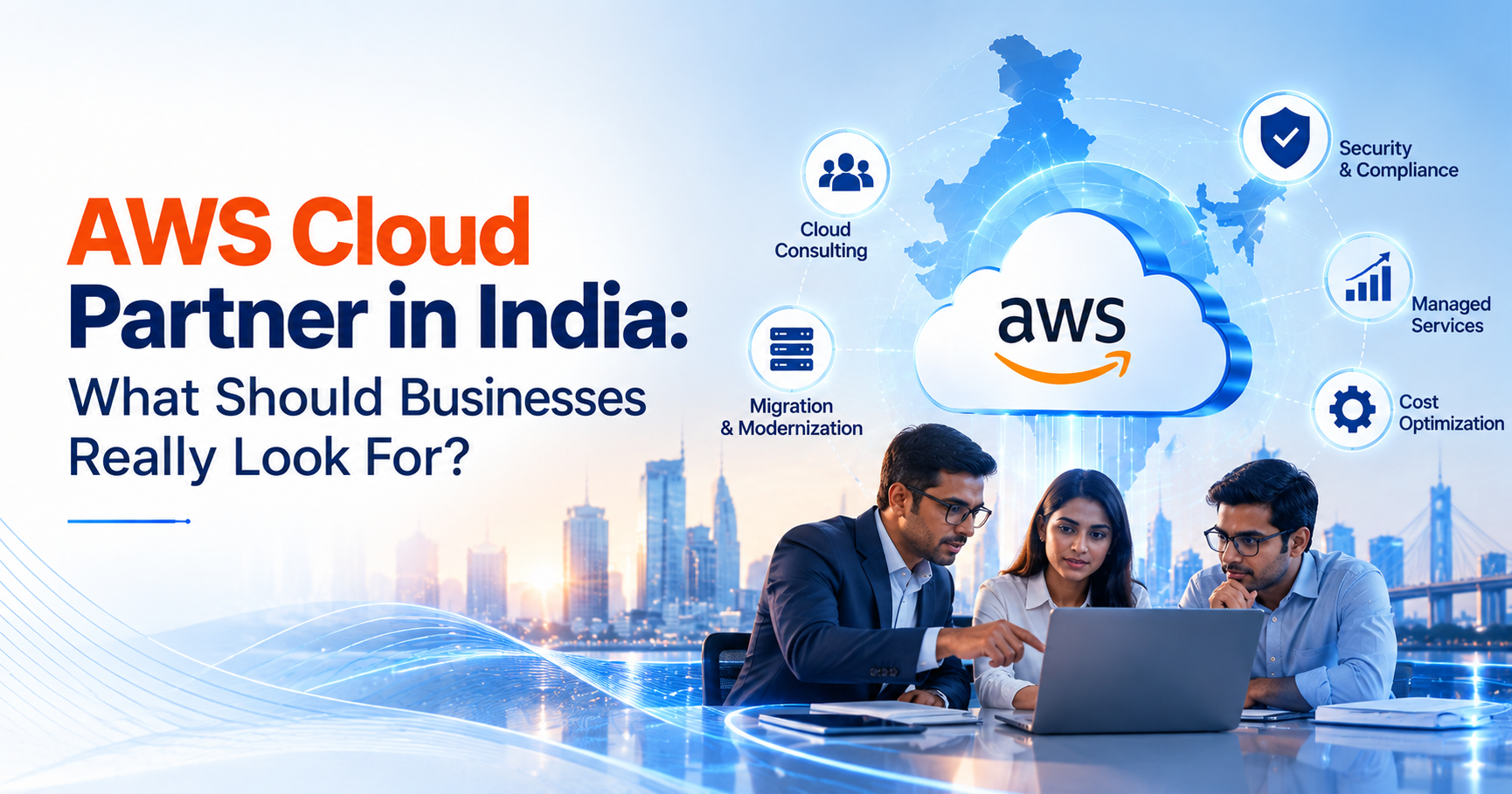
AWS Cloud Partner in India: What Should Businesses Really Look For?
Choosing a cloud partner is an important decision for any business planning to adopt or expand its Amazon Web Services (AWS) infrastructure. The right partner can help simplify cloud adoption, improve infrastructure efficiency and establish a stronger foundation for future growth.
However, not every provider offers the same capabilities. Some specialize in migration, while others focus on consulting, security, application modernization or ongoing cloud operations.
For businesses evaluating an AWS Cloud Partner in India, the challenge is finding a provider that understands both the technical requirements and the commercial objectives of the organization.
Why Does Choosing the Right AWS Partner Matter?
AWS provides a broad range of services for computing, storage, networking, databases, security and application development. Using these services effectively requires the right architecture, implementation strategy and operational processes.
Without proper planning, businesses may encounter unexpected cloud costs, migration delays, security gaps or difficulties managing their infrastructure.
An experienced AWS partner can help organizations evaluate their existing environment, identify suitable cloud solutions and develop a practical roadmap aligned with their business requirements.
The objective is not simply to move infrastructure to AWS. It is to make the cloud environment reliable, secure and efficient.
1. Verify AWS Partner Credentials and Expertise
The first step is to understand the provider's relationship with AWS and verify its relevant credentials.
AWS Partner Network participation and partner designations can help businesses evaluate a provider's capabilities. However, organizations should also examine the specific services offered, technical experience and qualifications of the team responsible for delivery.
Cogenerate presents itself as an Advanced Tier AWS Partner, with capabilities spanning cloud consulting, migration, modernization and managed services.
Businesses can explore its AWS cloud consulting and partner capabilities to understand the services available.
Remember that partner credentials are an important starting point, not a substitute for evaluating delivery experience and suitability for your project.
2. Look for End-to-End Cloud Capabilities
Cloud adoption involves several interconnected stages.
These can include infrastructure assessment, architecture design, migration planning, implementation, security, performance optimization and ongoing management.
Working with separate providers for every stage may increase coordination requirements and make responsibilities less clear.
An AWS cloud solutions provider with capabilities across multiple stages can help businesses maintain continuity as their cloud requirements evolve.
For example, a company may initially need migration assistance but later require monitoring, security improvements or infrastructure optimization.
Choosing a partner that can support these changing requirements may simplify long-term cloud management.
3. Evaluate AWS Migration Experience
Cloud migration is rarely a straightforward transfer of servers.
Applications may depend on databases, internal systems, network configurations, authentication services and third-party software. These dependencies need to be understood before workloads are moved.
Before selecting an AWS migration partner in India, ask how the provider approaches discovery, workload assessment, migration planning, testing and production cutover.
A structured migration process should identify potential risks, establish priorities and define how application functionality will be validated after migration.
The provider should also explain how it plans to minimize disruption to business operations.
Explore Cogenerate's assessment and migration services for information about its cloud migration offering.
4. Make Security a Priority
Security should be integrated into cloud architecture from the beginning.
Businesses need to consider identity and access management, encryption, network security, monitoring, backup and incident response.
Organizations handling sensitive information may also have specific regulatory or contractual requirements.
When evaluating an AWS consulting partner, ask how security is incorporated into architecture design and ongoing operations.
Cogenerate offers dedicated longside its broader cloud capabilities.
The goal is to establish security controls that match the organization's risk profile rather than relying on technology alone.
5. Understand the Managed Services Offering
Migrating to AWS is only one part of the cloud journey. Once workloads are running, businesses must still manage performance, availability, security, backups, patches and operational issues.
An AWS managed service provider can help organizations establish consistent processes for monitoring, maintenance, incident management and infrastructure optimization.
Before selecting a provider, clarify what is included in its managed services agreement.
Ask about monitoring coverage, incident escalation, response commitments, backup management, reporting and the responsibilities retained by your internal team.
You can review Cogenerate's managed services to understand its ongoing cloud management capabilities.
6. Ask How Cloud Costs Will Be Managed
Cloud costs can change as applications grow and resource consumption increases.
A capable AWS partner should understand how architecture decisions, resource utilization, storage and networking influence cloud expenditure.
Ask whether the provider can help establish cost visibility, review resource utilization, identify unnecessary expenditure and recommend appropriate optimization measures.
The objective should be to balance cost with application performance, security and reliability.
The cheapest infrastructure configuration is not necessarily the best choice if it compromises business-critical workloads.
7. Assess Technical Support and Accountability
A cloud partner should make responsibilities clear before a project begins.
Businesses should understand who manages implementation, who communicates project progress, how technical issues are escalated and who is responsible for ongoing support.
It is also useful to evaluate the team's experience with the specific technologies and workloads involved in the project.
Case studies, references and clearly defined service agreements can help businesses make a more informed decision.
8. Choose a Partner That Can Grow With Your Business
Cloud requirements rarely remain static.
An organization may begin by migrating a few applications and later introduce automation, modernization, analytics or more advanced security controls.
A suitable partner should be able to support this evolution without recommending unnecessary complexity.
For businesses seeking an AWS Cloud Partner in India, the strongest choice is one whose capabilities align with both immediate requirements and longer-term technology plans.
Why Consider Cogenerate for Your AWS Journey?
Cogenerate provides cloud consulting and related services covering assessment, migration, modernization, security, cost optimization and managed cloud operations.
This range of capabilities can help businesses evaluate their AWS requirements across different stages of cloud adoption.
Explore Cogenerate's AWS practice and its cloud consulting services to learn more about its approach.
Choosing an AWS Cloud Partner in India requires more than comparing prices or reviewing a list of services.
Businesses should evaluate partner credentials, migration experience, architecture expertise, security capabilities, cost management and ongoing support.
The right partner should understand your current infrastructure, your business objectives and the operational requirements that will emerge as your organization grows.
By assessing these factors carefully, businesses can make more confident cloud decisions and establish a stronger foundation for digital transformation.
Looking for a cloud strategy that supports your business goals? Explore Cogenerate's AWS capabilities and identify the right next step for your cloud journey.