
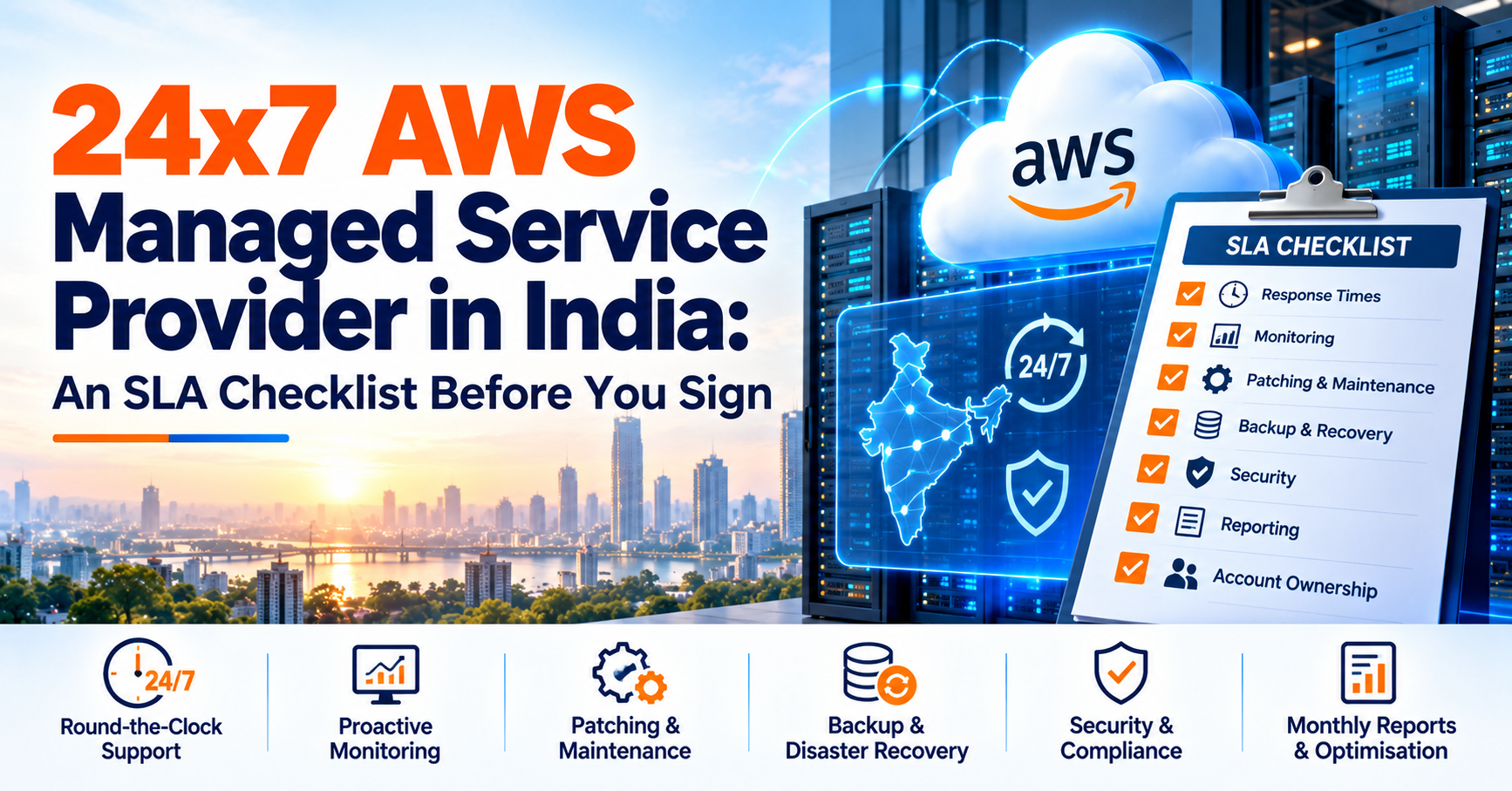
24x7 AWS Managed Service Provider in India: An SLA Checklist Before You Sign
Businesses running applications on Amazon Web Services (AWS) need more than cloud infrastructure. They also need continuous monitoring, security management, incident response and cost control. For organizations that depend on digital platforms throughout the day, an operational issue outside business hours can affect customers, revenue and business continuity.
This is why choosing a 24x7 AWS managed service provider in India requires careful evaluation. Before signing an agreement, businesses should understand exactly what the provider will manage, how quickly it will respond to incidents and which responsibilities will remain with the internal IT team.
A Service Level Agreement (SLA) establishes these expectations in measurable terms. Here is a practical checklist to review before making a commitment.
1. Define the Scope of Managed Services
Not every provider includes the same services in its managed support package. Some focus on infrastructure monitoring, while others offer comprehensive cloud operations.
Your SLA should clearly identify whether the provider will manage AWS infrastructure monitoring, operating system updates, security monitoring, backup configuration, performance optimization, incident response and cloud cost management.
The agreement should also specify which AWS accounts, workloads, applications and environments are covered.
Businesses evaluating these requirements can explore Cogenerate’s cloud consulting services for information about its cloud strategy, managed cloud and optimization capabilities.
2. Check Response and Resolution Commitments
One of the most important SLA components is incident management. However, response time and resolution time are not the same.
Response time measures how quickly the provider acknowledges an incident and begins handling it. Resolution time measures how long it takes to restore service or resolve the underlying problem.
Your SLA should define severity levels, such as critical, high, medium and low, with specific response commitments for each. For example, a business might negotiate a 15-minute response target for critical production incidents. This is an illustrative target, not a universal AWS standard.
The agreement should also explain escalation procedures, communication channels and the process for handling incidents that cannot be resolved immediately.
3. Verify Genuine 24x7 Coverage
A provider advertising round-the-clock support should explain how that coverage operates.
Ask whether monitoring and incident response are available 24 hours a day, including weekends and public holidays. Determine whether an engineer can actively investigate critical incidents or whether the service only generates automated alerts.
Also clarify how emergency communication works. The agreement should identify escalation contacts, notification methods and the circumstances under which your internal team will be contacted.
4. Review Security and Access Responsibilities
AWS follows a shared responsibility model. AWS secures the underlying cloud infrastructure, while customers remain responsible for security measures associated with their configurations, workloads and data.
Your managed services SLA should identify responsibility for identity and access management, encryption, security monitoring, vulnerability remediation, audit logs and incident coordination.
Organizations handling sensitive information should also review data handling, confidentiality, retention and contractual compliance requirements.
Explore Cogenerate’s security solutions to understand its broader approach to cloud security.
5. Confirm Backup and Disaster Recovery Arrangements
Backups are useful only when they can be restored successfully. Before signing, establish who configures backups, monitors failures, verifies retention policies and conducts recovery tests.
Two important metrics are Recovery Time Objective (RTO), which defines the acceptable time to restore a service, and Recovery Point Objective (RPO), which defines the acceptable amount of data loss measured in time.
Your SLA should state the agreed RTO and RPO for relevant workloads, along with the scope and frequency of recovery testing.
6. Understand Reporting, Pricing and Exit Terms
A reliable managed services agreement should include periodic reports covering availability, incidents, security findings, backup status, resource utilization and optimization recommendations.
Clarify whether the fee covers monitoring only, hands-on engineering, after-hours incident response or a defined number of support hours. Establish how additional work is charged and whether AWS consumption charges are separate from the provider's fees.
Finally, review termination notice periods, documentation ownership, access revocation and transition assistance.
7. Use This SLA Checklist Before Signing
Before approving the contract, confirm that the SLA defines service scope, incident severity, response targets, escalation procedures, security responsibilities, backup policies, reporting frequency, commercial terms and exit arrangements.
The provider should explain these terms clearly and align them with your business's availability and risk requirements.
To discuss your cloud operations and support requirements, contact Cogenerate.
Frequently Asked Questions
What is an AWS managed services SLA?
An AWS managed services SLA is an agreement defining the services a provider delivers, its support commitments, incident response targets, responsibilities, reporting requirements and applicable contractual remedies.
What should a 24x7 AWS managed service provider include?
Depending on the agreed scope, services may include continuous monitoring, incident response, security management, patching, backup oversight, performance optimization and cloud cost management.
Is response time the same as resolution time?
No. Response time measures how quickly an incident is acknowledged and action begins. Resolution time measures how long it takes to resolve the issue or restore the affected service.
Does AWS guarantee that every application will have zero downtime?
No. Availability depends on architecture, configuration, dependencies and operational practices. Businesses should establish appropriate resilience measures and realistic availability objectives.
How can a business choose an AWS managed service provider in India?
Evaluate technical expertise, genuine 24x7 coverage, SLA clarity, security practices, disaster recovery capabilities, reporting quality, pricing transparency and exit arrangements before signing.