
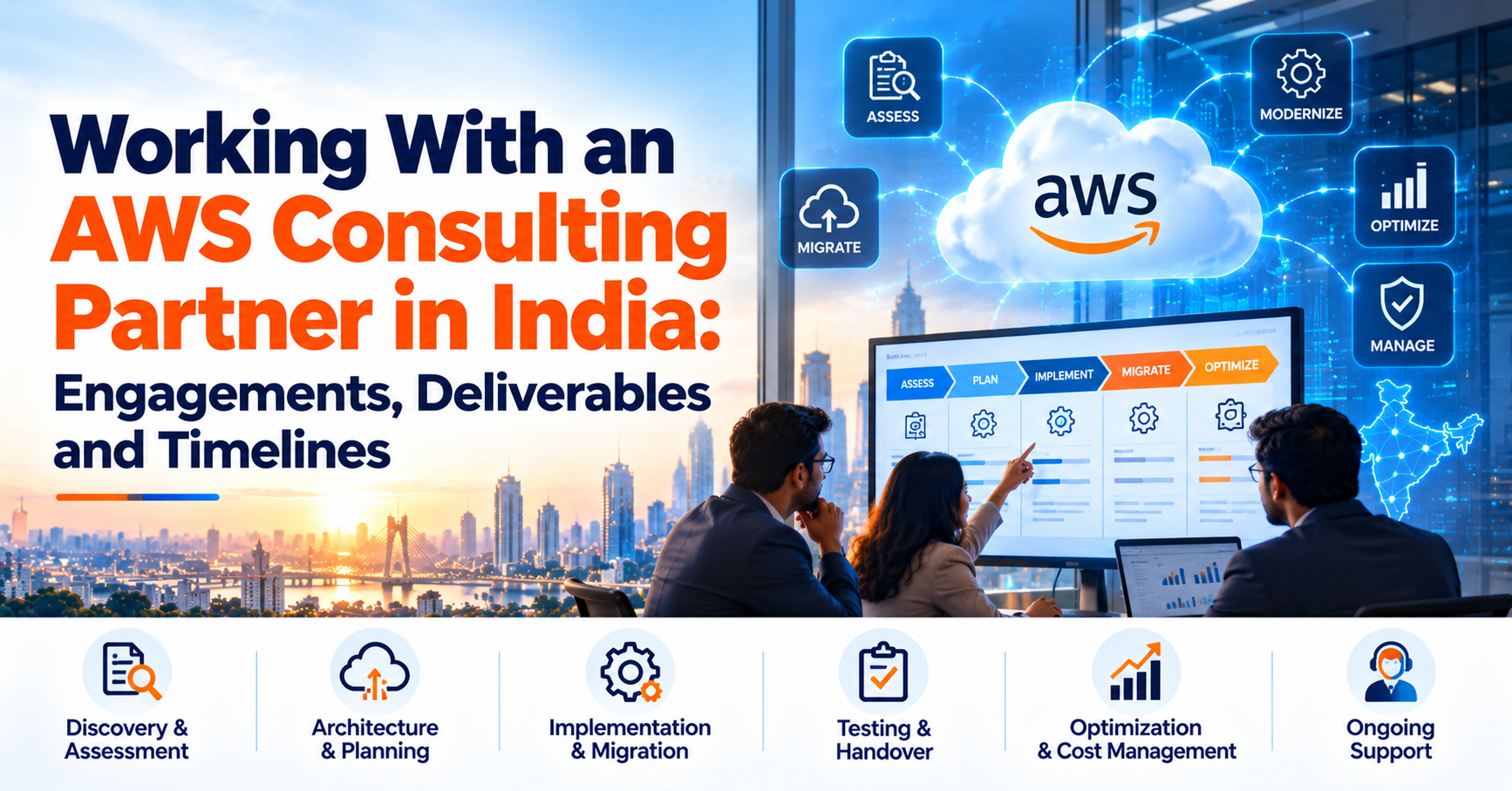
Working With an AWS Consulting Partner in India: Engagements, Deliverables and Timelines
Adopting Amazon Web Services (AWS) involves more than selecting cloud services and moving applications. Organizations must evaluate existing infrastructure, define business objectives, plan architecture, manage security and prepare for ongoing operations.
An AWS consulting partner in India can help coordinate these activities, particularly when an internal team lacks specialist cloud expertise or needs additional implementation capacity.
However, businesses should understand how consulting engagements are structured, what deliverables they should expect and how long each stage may take before entering into an agreement.
1. What Does an AWS Consulting Partner Do?
An AWS consulting partner helps organizations make technical and operational decisions about cloud adoption.
Depending on the engagement, services may include cloud readiness assessment, architecture design, migration planning, infrastructure implementation, security reviews, cost optimization and post-migration support.
The engagement may be advisory, implementation-focused or end-to-end.
An advisory project might deliver a cloud roadmap without executing the migration. An implementation engagement may include environment configuration, application deployment, testing and production cutover.
Before selecting a partner, clarify whether your organization needs strategic guidance, hands-on engineering or continuing operational support.
Businesses can explore Cogenerate’s cloud consulting services to understand its broader cloud strategy, security, migration and managed cloud capabilities.
2. Phase One: Discovery and Assessment
The first stage establishes the current situation and defines the desired outcome.
The consulting team typically gathers information about applications, servers, databases, network architecture, licensing, security controls, performance and business dependencies.
Stakeholders should also identify business priorities, budget constraints, downtime tolerance and regulatory requirements.
Typical deliverables include:
-
Current infrastructure and workload inventory.
-
Cloud readiness and dependency assessment.
-
Initial risk register.
-
Preliminary cost estimates.
-
Recommended migration priorities.
-
Assessment findings and next steps.
A small, well-documented environment may take a few days to assess. A complex enterprise environment can require several weeks or longer.
The timeline depends on access to technical information, stakeholder availability and the number of systems involved.
3. Phase Two: Architecture and Migration Planning
After discovery, the consulting partner develops a target-state design and implementation roadmap.
This stage considers AWS accounts, networking, identity and access management, compute, databases, backup, monitoring, security and disaster recovery.
The architecture should reflect business requirements rather than simply reproduce the existing infrastructure.
The migration plan should define workload sequencing, testing requirements, dependencies, maintenance windows, rollback procedures and acceptance criteria.
Expected deliverables may include architecture diagrams, a migration schedule, a resource estimate, security recommendations and a detailed implementation plan.
For organizations moving existing applications to AWS, Cogenerate’s AWS assessment and migration services provide a relevant starting point for understanding assessment, discovery and migration planning.
4. Phase Three: Implementation and Migration
The implementation stage converts the approved plan into a working cloud environment.
Activities may include configuring AWS accounts, establishing network connectivity, implementing security controls, provisioning infrastructure and migrating applications or databases.
Some workloads can be moved with limited changes. Others require application modifications, database compatibility work or integration testing.
A typical engagement may also include development and staging environments before production deployment.
Deliverables should be explicitly agreed upon. They may include configured infrastructure, deployment scripts, migration records, test results, configuration documentation and a production cutover report.
The project timeline depends heavily on the number of workloads, complexity of dependencies, data volume and acceptable downtime.
A small workload may be migrated within days once preparation is complete. A multi-application enterprise migration may take several months or longer.
These are indicative planning ranges, not guaranteed delivery commitments.
5. Phase Four: Testing, Validation and Handover
A successful migration is not complete merely because an application starts running on AWS.
The business must verify functionality, performance, security, data integrity and connectivity with dependent systems.
Testing should include appropriate application workflows, user acceptance, backup verification and recovery procedures. The team should also confirm monitoring, alerting and operational access.
The handover should provide the internal IT team with the documentation needed to operate the environment.
Depending on the engagement, this can include architecture diagrams, access procedures, operational runbooks, known limitations, backup policies, escalation contacts and outstanding issues.
Acceptance criteria should be agreed upon before implementation begins so both parties understand what constitutes completion.
6. Phase Five: Optimization and Managed Operations
After production deployment, cloud usage and operational needs may change.
Organizations should review resource utilization, application performance, security findings, storage growth and cloud expenditure. Optimization may include right-sizing resources, improving monitoring and adjusting backup policies.
Businesses that lack sufficient internal operational capacity may also require managed services for monitoring, incident response, patch management and cost control.
Cogenerate’s cloud consulting and managed cloud services include managed cloud support and cost optimization as part of its broader service offering.
The important consideration is to define whether post-migration operations are included in the original contract or require a separate engagement.
7. How to Select the Right Engagement Model
Three common models are useful to consider.
Fixed-scope project: Appropriate when requirements, deliverables and acceptance criteria are clearly defined.
Time-and-materials engagement: Suitable when the scope may evolve or technical discovery is still underway. Cost controls and approval procedures remain important.
Ongoing managed services: Appropriate when the organization needs continuing monitoring, maintenance and operational support after implementation.
Regardless of the model, the contract should define responsibilities, exclusions, timelines, dependencies, payment milestones, change requests and knowledge transfer.
An AWS consulting partner should explain trade-offs openly and align recommendations with business objectives.
Organizations can contact Cogenerate to discuss their cloud consulting or migration requirements.
Frequently Asked Questions
What does an AWS consulting partner deliver?
Depending on scope, deliverables may include an infrastructure assessment, cloud roadmap, architecture design, cost estimates, migration plan, implementation, testing documentation and operational handover.
How long does an AWS migration project take?
A simple migration may take days or weeks after preparation, while complex enterprise migrations can take several months or longer. The actual duration depends on workload complexity, dependencies, testing and downtime requirements.
What is the difference between AWS consulting and managed services?
Consulting generally focuses on planning, architecture, implementation or specific improvements. Managed services provide ongoing operational support, such as monitoring, maintenance, incident response and optimization.
Should businesses choose a fixed-price or time-and-materials engagement?
Fixed-price projects work well when scope and acceptance criteria are stable. Time-and-materials engagements offer flexibility when requirements are uncertain, provided spending and scope are actively controlled.
What should be included in an AWS consulting contract?
The contract should define scope, deliverables, milestones, responsibilities, security requirements, acceptance criteria, change management, commercial terms and knowledge transfer.