
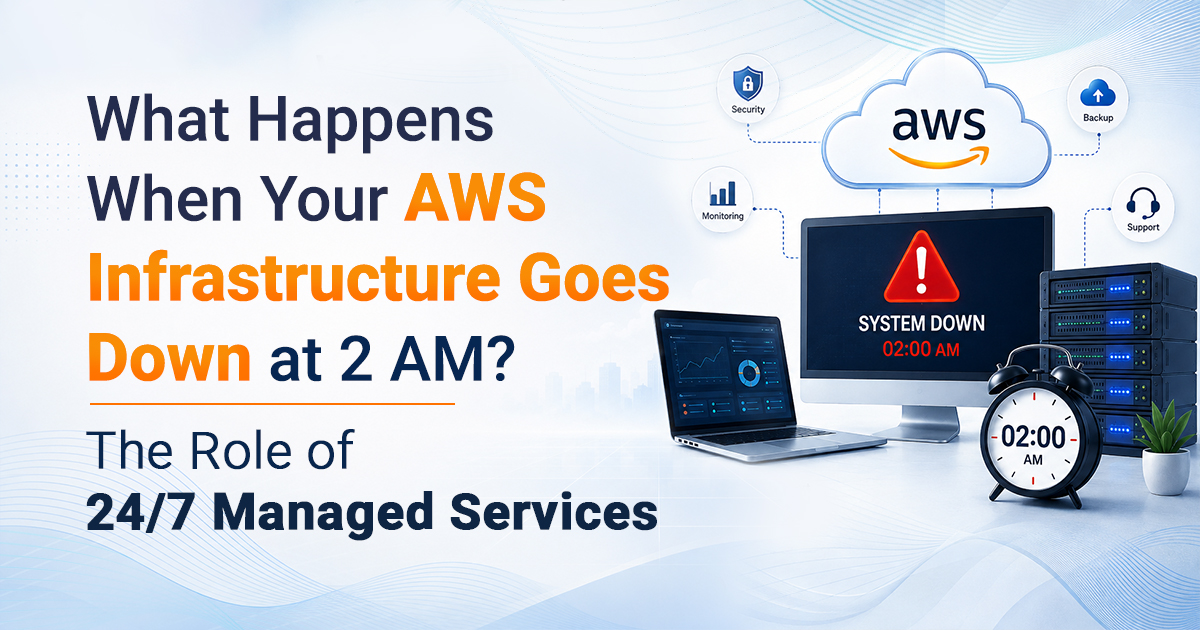
What Happens When Your AWS Infrastructure Goes Down at 2 AM?
Imagine this: it is 2 AM, your customers are trying to access your application, and suddenly the website stops responding. Your team is asleep, the office is closed, and nobody knows what caused the problem.
For businesses running critical applications on AWS, infrastructure issues can happen at any time. A server may become unavailable, an application may slow down, a database may experience an issue, or a security alert may require immediate attention.
This is why simply moving your workloads to AWS is not always enough. Businesses also need a reliable system for monitoring, managing, and responding to problems around the clock. This is where 24/7 AWS managed services in India can play an important role.
Why Can AWS Infrastructure Problems Happen?
AWS provides highly reliable cloud infrastructure, but that does not mean every application running on AWS will automatically be problem-free.
Issues can occur because of:
- Incorrect configurations
- Application errors
- Database problems
- Sudden traffic increases
- Resource exhaustion
- Security incidents
- Network configuration issues
- Software or operating system problems
- Unexpected cloud resource usage
Sometimes the issue may be with the application rather than AWS itself. Identifying the actual cause quickly is therefore important.
The longer a critical application remains unavailable, the greater the potential impact on customers, employees, and revenue.
What Happens Without 24/7 Monitoring?
Consider a business that operates during the day but receives customers and transactions throughout the night.
If its AWS environment is monitored only during office hours, an infrastructure problem that starts at 2 AM may remain unnoticed for several hours.
By the time the technical team discovers the issue in the morning:
- Customers may have already faced service disruptions.
- Transactions may have been affected.
- Employees may have received complaints.
- Business data may need to be checked.
- The technical team may have to spend hours identifying what happened.
This reactive approach can make a relatively small issue much more difficult to manage.
What Happens With 24/7 AWS Managed Services?
With 24/7 AWS managed services in India, an AWS environment can be continuously monitored by a dedicated technical team.
Monitoring systems can track important infrastructure and application metrics and generate alerts when something goes wrong.
For example, the team may receive alerts about:
- High CPU or memory utilization
- Application downtime
- Unusual network activity
- Database performance problems
- Failed services
- Security events
- Storage issues
- Unexpected resource usage
The objective is simple: identify problems early and respond before they create a larger business impact.
Incident Response Matters
Monitoring is only useful when someone can act on the alerts.
Suppose a production application suddenly becomes unavailable at 2 AM. A proper managed services team can investigate the alert, identify the affected resources, check logs and infrastructure metrics, and begin troubleshooting.
Depending on the nature of the problem, the team may restart services, address configuration issues, scale resources, restore services, or escalate the incident to the appropriate technical team.
This creates a structured incident-response process rather than leaving the business waiting until morning.
Security Cannot Wait Until Morning
Security incidents do not follow business hours.
An unusual login, suspicious activity, unexpected traffic pattern, or compromised resource can appear at any time.
Continuous monitoring can help businesses identify potentially suspicious activity faster and initiate the appropriate response.
A managed AWS environment can also include regular security reviews, access management, patching, backup monitoring, and other security-related activities.
This is particularly important for businesses handling customer information, financial data, healthcare information, or other sensitive business data.
Backup and Disaster Recovery
Another important part of AWS management is making sure that business data can be recovered when something goes wrong.
Having backups is not enough. Businesses should also understand:
- What is being backed up?
- How frequently are backups created?
- Where are backups stored?
- Are backups completing successfully?
- How quickly can systems be restored?
- Has the recovery process been tested?
A managed services team can monitor backup processes and help businesses maintain appropriate disaster recovery procedures.
This provides an additional layer of protection against infrastructure failures, accidental deletion, application problems, and other incidents.
AWS Cost Problems Can Also Happen Overnight
Downtime is not the only problem that can occur outside business hours.
Cloud costs can also increase unexpectedly.
For example, a sudden increase in traffic could cause additional resources to be launched. An incorrectly configured service could continue consuming resources. Unused infrastructure might remain active for weeks.
Without regular monitoring and optimization, businesses may discover these problems only when they receive their AWS bill.
Ongoing cloud management can help identify unused resources, inefficient configurations, and opportunities for right-sizing.
Performance Monitoring Is Equally Important
Sometimes the infrastructure does not completely go down—it simply becomes slow.
From a customer's perspective, a website that takes 10 seconds to load can be almost as frustrating as a website that is completely unavailable.
Performance monitoring helps identify changes in resource utilization and application behavior.
A managed services team can investigate performance issues and determine whether the problem is related to infrastructure, databases, networking, application configuration, or increased demand.
This becomes especially important for businesses with applications that need to remain available 24/7.
Why Businesses Choose Managed AWS Support
Managing AWS internally can work well when a company has an experienced cloud engineering team and sufficient resources for continuous monitoring and support.
However, maintaining a dedicated team for 24/7 operations can be difficult and expensive for many organizations.
This is one reason businesses consider 24/7 AWS managed services in India. Instead of building a large internal cloud operations team, businesses can work with an experienced service provider that manages key AWS operations on an ongoing basis.
This can allow internal teams to focus more on application development, business initiatives, and strategic technology projects.
What Should You Look for in an AWS Managed Services Provider?
Not every managed services provider offers the same level of support.
Before choosing a provider, businesses should look at:
24/7 monitoring: Make sure the environment is monitored continuously, not only during office hours.
Incident response: Understand how alerts are handled and how quickly the team responds.
Security: Check whether security monitoring and best practices are part of the service.
Backup and disaster recovery: Ask how backups are monitored and how recovery is handled.
Cost optimization: Look for regular reviews of AWS resource usage and spending.
Technical expertise: Choose a provider with practical experience managing AWS environments similar to yours.
Reporting: Regular reports can help you understand infrastructure performance, incidents, security, and costs.
An AWS migration can give your business a powerful and scalable cloud infrastructure, but maintaining that environment requires ongoing attention.
When something goes wrong at 2 AM, the important question is not simply whether AWS is reliable. The real question is who is watching your environment and who will respond when something goes wrong?
With the right monitoring, incident response, security practices, backup strategy, and cost optimization, businesses can reduce operational risks and keep their critical workloads running more reliably.
For organizations that do not have the resources to manage AWS infrastructure around the clock, 24/7 AWS managed services in India can provide the ongoing expertise and support needed to keep cloud environments secure, monitored, optimized, and ready to respond when problems occur.